
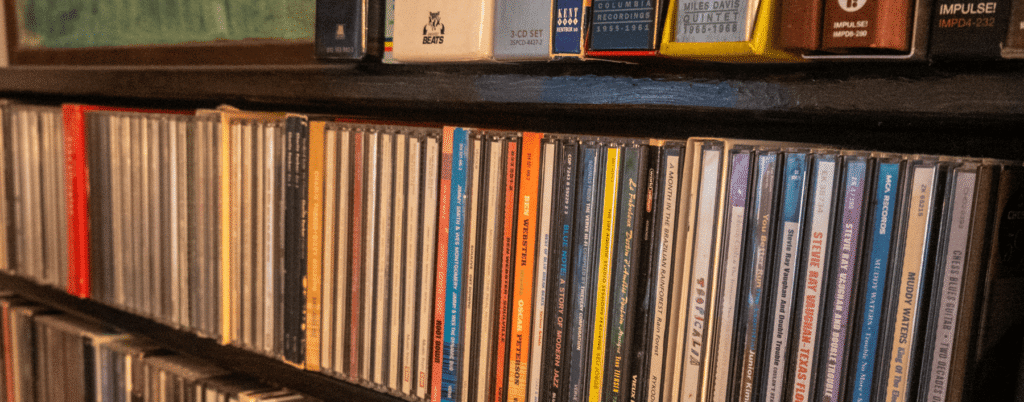
“Dad, if you ever want to get rid of some of these,” gesturing towards my CD tower gathering dust since the mid-2010s, “I’m getting into physical media.”
As they were about to turn sixteen, I found a replacement for the last discman I ever owned: a late-model with “bass boost” and, more importantly, 40 seconds(!) of skip protection. The next weekend, I zipped up my entire 90s alternative/grunge/punk collection into a 100-CD wallet.
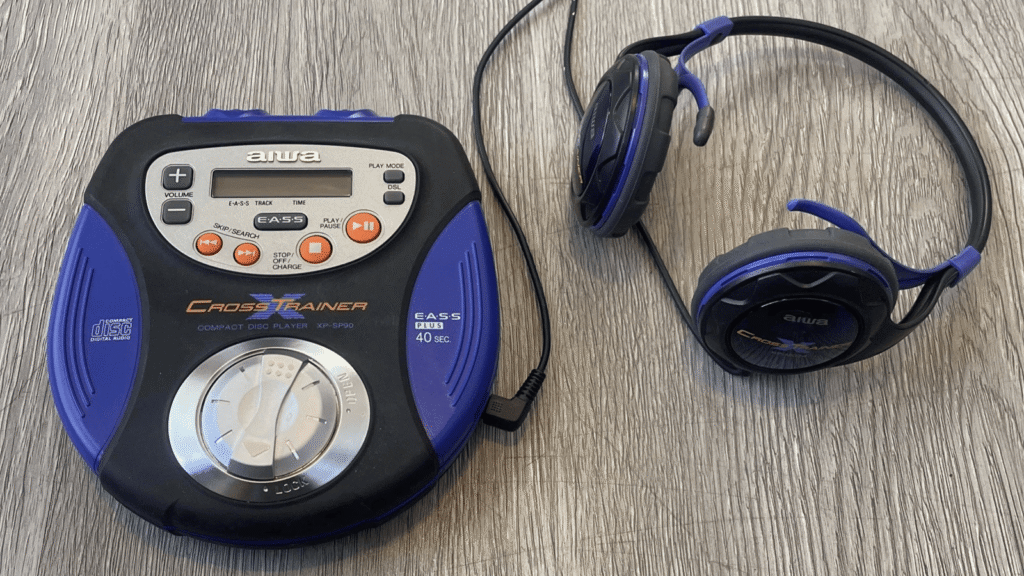
The headphones were total garbage, but their wrap-around form factor were at least an attempt at millenial-futurist industrial design
“I have no clue what this is,” unwrapping the birthday present before the reveal: Weezer, Green Day, Nirvana, Hole, Soundgarden (I held onto Pinback – sorry, kiddo!). Page after page, taking in their new bounty, both of us grinning ear-to-ear.
This kid, along with their peers, was opting out of streaming algorithms online in favor of tactile experiences. Maybe someday they’ll look at my video library and remember the countless pandemic hours we spent on a deep-dive of Hong Kong action films. They’re welcome to my Blu-rays, because, along with my CDs, they’re all (well, mostly) ripped and stored on hard drives.
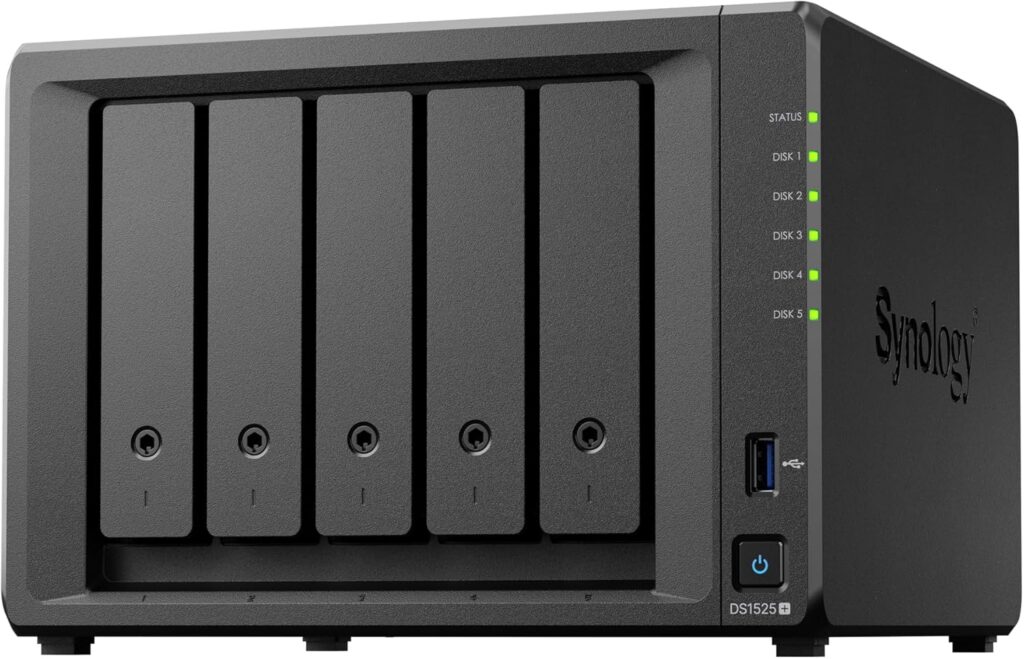
Last July, when the Bay Area was false-alarmed of an impending tsunami, I had to take an extra trip upstairs just to grab this ungainly beast.
Preparing for the Big One
Or rather, they were. Recently, my Synology NAS had a failure. Of course I’d purchased extra hard drives, knowing eventually one or two would fail, potentially losing all my media. But this I couldn’t plan for: something in the chassis had died. The power supply was still functioning, but the system wouldn’t boot. LEDs blinked for a few minutes, power down, then start up again.
Trusting my data was intact, I had a choice: buy a new NAS and hope to recover the data by migrating the drives, maybe… but then what? Wait around for the spinning platters to finally rust? Hope this new chassis doesn’t suffer the same fate? Fool me once, shame on you.
It was time to upgrade to durable storage that won’t be a ticking time bomb for my library. All the movies, music, photos, and other digital media I’ve collected, created, and curated for decades deserves to stick around at least long enough for the next generation to have another revelation.
Fast, secure, solid-state storage from iodyne was the clear way forward. Instead of a big ugly box with noisy fans blaring away in a closet, Pro Data is sleek and quiet enough to sit on my desk, and compact enough to throw in a backpack when the Big One hits.
So the choice became obvious: buy a new empty NAS, restore my media to Pro Data, then promptly return the new NAS. Fool me twice, shame on me.
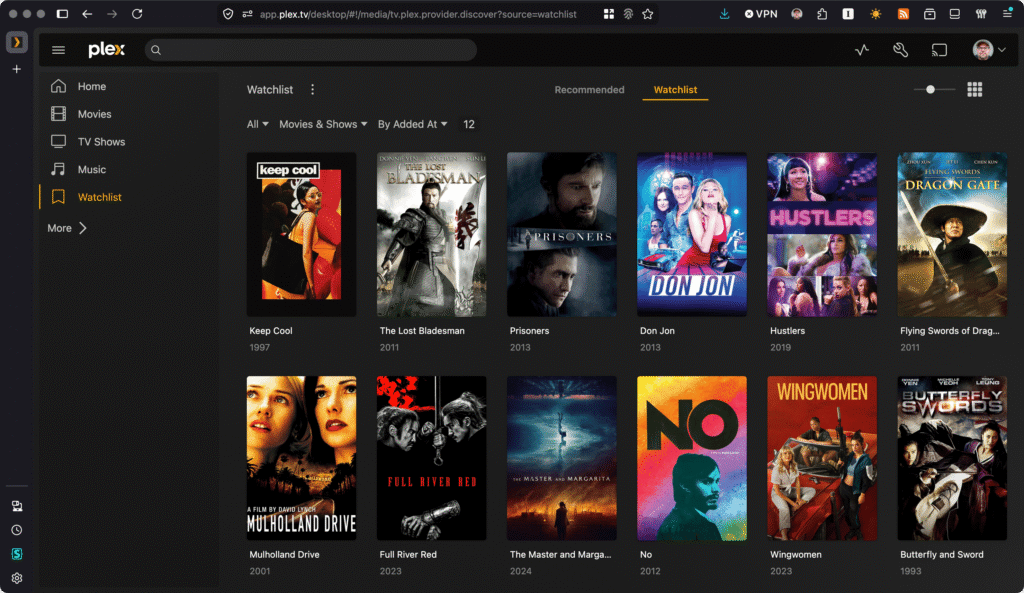
Configuring for Media Access (and much more)
Once my data was migrated to an encrypted, password-protected RAID-6 container, setting up Pro Data to serve up my media couldn’t have been simpler. I bought a lifetime subscription to Plex back before they raised their prices, so that was an easy call. But since then, several free and open-source alternatives have been cropping up, and they’re just as easy to configure: point the server app at a directory each for movies, TV shows, music, and photos, and it does the hard work of indexing and attaching cover art in the background. Corresponding apps for your computers, tablets, phones, and smart TVs then have access to your media anywhere in the world, and bingo – you’ve got your very own streaming service, with all your favorite stuff!
But of course that’s not all Pro Data enables. Because NAS boxes are notoriously underpowered CPU-wise (and GPU capabilities are worse, if they exist at all), they may claim to be able to do things like transcoding video, but the reality falls well short of that.
With a basic M4 Mac Mini connected to Pro Data, I’m currently transcoding multiple Blu-ray rips to h.265 using Handbrake while running an open-source LLM to upscale a 480p fan edit I found online. Meanwhile, if I ever have an issue with my Mac Mini, I can connect Pro Data to my laptop and pick right back up where I left off, instead of losing access to my media while the Mac Mini’s under repair.
The fact is, when I bought my NAS there were no viable options for solid-state storage on the scale that I’d need to contain all my media – especially not with the flexibility and serviceability that Pro Data provides. Thankfully, those dark times are gone, and I have more peace of mind that the next time one of my kids starts eyeing my physical media, I won’t have to worry that I don’t have a rock-solid backup.
Todd Patrick is a creative director in the East Bay, where he keeps his vinyl collection closely guarded.