TruePut™

A better way to apply storage performance metrics in media workflows.

TruePut captures sustained throughput over an entire task, and considersvarying contexts, andreal-world scenarios like offloading big data, rendering, or playing back media in real-time.

Take the guesswork out of data transfers.
Plan, schedule, and execute your workflow based on predictable outcomes.
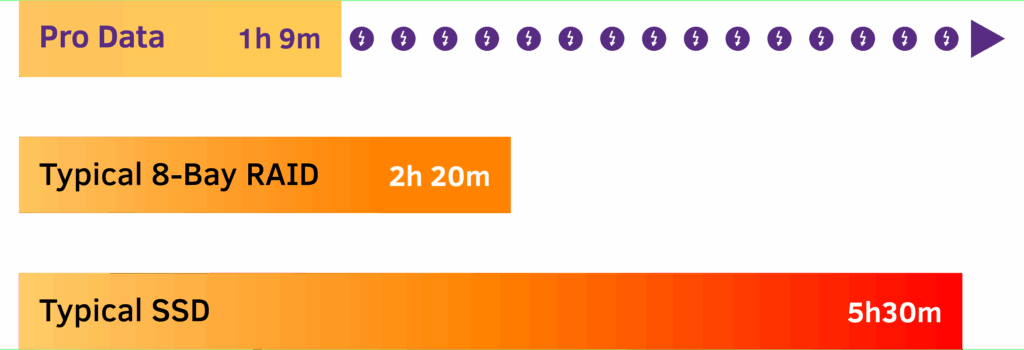
How long does it take to ingest 10TB?

Pro Data transfer time comparison: 1h 9m vs. Typical 8-Bay RAID 2h 20m and Typical SSD 5h 30m, highlighting Iodyne's TruePut™ technology for enhanced media workflow efficiency.

What does this mean for my production?

See how we do the math

What your hard drive isn’t telling you.

Ever started an offload that says 40 minutes—only to return 15 minutes later and see the load bar is now at 1 hour and 20 minutes?

That disconnect between what’s promised and what is actually delivered highlights a deeper issue:peak performance numbers can’t predict how storage is used in production.

When we make an external storage purchase decision, performance metrics like “up to 2800MB/s!” are one of the top criteria we consider. But what customers often don’t realize is that poor cooling, small DRAM caches, and other factors mean those numbers rarely hold up.

What matters more is predictable,sustained throughput that doesn’t crumble halfway through your data transfer. At iodyne, we call it TruePut (see how we measure it). 

Let us explain more.

What is throughput?

Throughput is the amount of data that moves through a system over time—measured in Megabytes per second (MB/s) or Gigabytes per second (GB/s). This is the number you will find printed on the packaging of any hard drive or portable SSD. That’s the number widely advertised when a hot new, fastest-ever device comes out.

But there is a caveat to that.

The problem with peak performance

The throughput figure is typically measured at peak performance under ideal conditions. Most drives can perform at their advertised speed for small loads of data, or the first few seconds and minutes of a job. 

However, various benchmarks that industry leaders like Tom’s Hardware have been running show that throughput is hardly a metric a professional production can rely on. 

Why does performance drop?

A few reasons most systems fail to sustain speed:

🌡️ Thermal throttling

🧠 System or OS overhead

🔌 Cabling and interface bottlenecks

🔒 Encryption overhead

🧰 RAID complexity

💾 DRAM/SRAM caching and SLC caching

All of these can degrade the advertised throughput, just when you need it most.

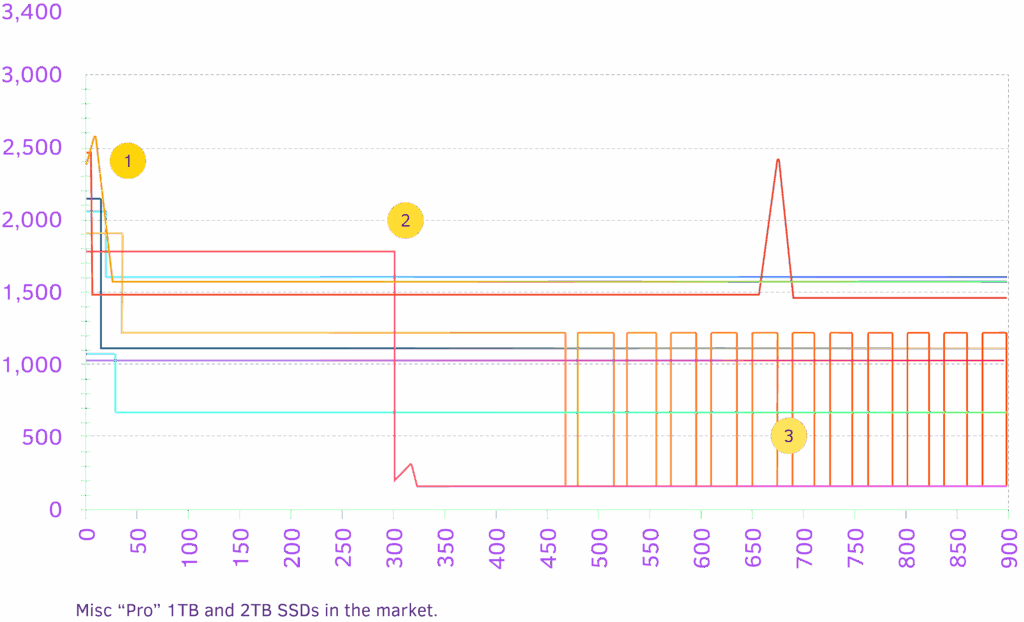
Graph showing performance benchmarks of various 1TB and 2TB SSDs, illustrating throughput drop-off over time, relevant to media production data transfer challenges.
Yellow circle with the number "1" in purple, symbolizing peak performance metrics in data storage, relevant to Iodyne's TruePut™ technology for media production.Typical SSD performance falls off right after a 20-second benchmark.
Number 2 in bold purple font on a bright yellow circular background, representing data management and performance metrics in media production. Some SSDs support a longer throttle time but with a much steeper falloff.
Yellow background with a large purple number 3, symbolizing data transfer performance metrics in media production contexts. Some SSDs show pathological bimodal performance after 7 minutes.


What does this mean in a real-world scenario?

Ideal conditions can start falling apart at a film set under hot lights or on location, for a VFX studio rendering terabytes by the hour, or during a live event recording and broadcasting multi-cam footage. These are everyday conditions for media professionals, but not ideal for “throughput.”

For example, a commercial production team expects to ingest 8TB of raw footage in 1.5 hours at 1400MB/s. Except that speed only lasts for 30 seconds. The real transfer time takes nearly 3 hours, holding up the rest of the cast and crew from moving on to the next shot or wrapping the set. Multiply that by 30+ days of production, and you’ve lost 45+ hours just waiting on data.

A stalled ingest doesn’t just waste time —it burns money. With a few editors and assistants on the clock, every three-hour delay can cost thousands in project-based budgets. No one’s billing for that time, but everyone feels it: interrupted creative flow, late nights, and stalled schedules that block the next project from even starting. Multiply that across a season or a campaign, it adds up to a substantial opportunity cost.

It’s not bad planning. It’s that most storage can’t sustain its peak performance.

Calculator graphic illustrating cost implications of production delays, highlighting potential overspending of ,000 for a 30-day studio production and ,000 for an indie or non-scripted show.

Let’s talk about TruePut™

Purple bar with lightning bolt icons, representing Iodyne's TruePut™ technology for sustained data transfer performance in media production workflows.

At iodyne, we approach storage performance metrics to reflect how pros work and to better understand the optimal setup for various day-to-day tasks with long durations. This requires measuring the performance of the storage solution over an extended period of time, where it can sustain optimal speed.

This is why we employ a different set of metrics, which we can then translate to the actual context of a production, and begin to make healthy estimates around job completion.

  • Minutes per Terabyte (MTB)
    For example: iodyne Pro Data has up to 7 MTB.
    This means: it ingests 1TB cam card in 7 minutes, or copies 1TB in 7 minutes. 

  • Terabytes per Hour (TBH)
    For example: iodyne Pro Data has up to 19 TBH.
    This means: it offloads 19TB in an hour.

TruePut facts sheet for Iodyne Pro Data showing optimal workflows on RAID-0, including performance metrics like 18.3 TB/h read speed, 8.6 TB/h write speed, and capacities ranging from 12TB to 192TB.
TruePut performance metrics for Iodyne Pro Data on RAID-6, showcasing storage capacity, encryption, and sustained performance rates including 18.7 TB/h read and 6.4 TB/h write.
Read about our performance tests

Why does TruePut matter?

Productions are complex operations with countless variables—weather delays, talent availability, tight turnaround windows, and location logistics that rarely go as planned. Amid all that unpredictability, having control over your data pipeline is one of the few things you can lock down.

High-res cameras, multicam setups, virtual production, and live workflows generate massive volumes of data—daily. Reliable, sustained performance is critical to keeping the shoot moving and post-production on schedule.

Trueput delivers sustained, predictable performance that keeps data flowing and workflows on schedule. Not just a flash-in-the-pan benchmark. A true measure of how fast you can move.

Purple bar with lightning bolt icons, representing Iodyne's TruePut™ technology for sustained data transfer performance in media production workflows.

When speed is not a variable, you have a pipeline you can trust.

Engineered by iodyne’s storage veterans, TruePut™ is baked into the design philosophy and performance testing of iodyne.

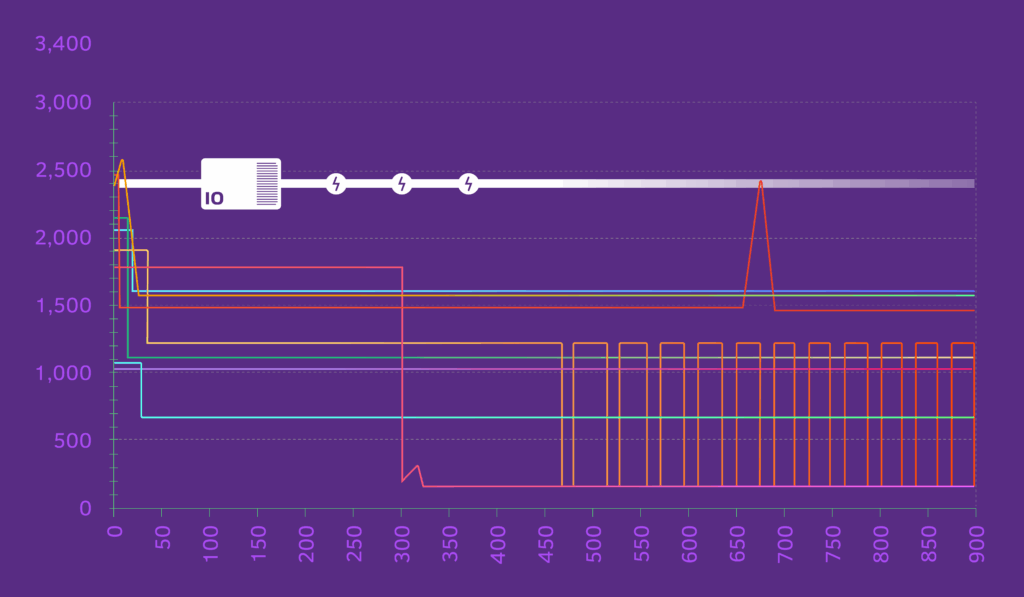
Pro Data and Pro Mini boast the fastest sustained Thunderbolt speeds while fully-encrypted and RAID-protected. Meanwhile supporting accessories like Pro Cables ensure stable, full-speed data transfers between powerful devices.

Graph illustrating sustained data throughput performance metrics, showcasing multiple lines representing different data transfer rates over time, relevant to Iodyne's TruePut™ technology for reliable media workflows.

iodyne’s TruePut enables:

Thunderbolt symbol representing high-speed data transfer and connectivity, relevant to iodyne's TruePut technology for reliable media workflows. Predictable timetables and scheduling from pre-production through post.


Thunderbolt symbol representing high-speed data transfer and connectivity, relevant to iodyne's TruePut technology for reliable media workflows. Accurate offload estimates with no surprises

Thunderbolt symbol representing high-speed data transfer and connectivity, relevant to iodyne's TruePut technology for reliable media workflows. Budget savings thanks to better utilization of crew and gear time

Thunderbolt symbol representing high-speed data transfer and connectivity, relevant to iodyne's TruePut technology for reliable media workflows. Faster access to dailies and quicker creative feedback

Thunderbolt symbol representing high-speed data transfer and connectivity, relevant to iodyne's TruePut technology for reliable media workflows. On-set grading and transcodes while shooting

Thunderbolt symbol representing high-speed data transfer and connectivity, relevant to iodyne's TruePut technology for reliable media workflows. Simultaneous shooting and editing workflows

Thunderbolt symbol representing high-speed data transfer and connectivity, relevant to iodyne's TruePut technology for reliable media workflows. High-resolution playback without dropped frames

Thunderbolt symbol representing high-speed data transfer and connectivity, relevant to iodyne's TruePut technology for reliable media workflows. Smoother handoffs across all stages of the pipeline

Thunderbolt symbol representing high-speed data transfer and connectivity, relevant to iodyne's TruePut technology for reliable media workflows. Editors, colorists, and VFX can start instantly

Thunderbolt symbol representing high-speed data transfer and connectivity, relevant to iodyne's TruePut technology for reliable media workflows. Studio equipment freed up for new jobs faster

Impact of iodyne Pro Data’s TruePut

Iodyne TruePut technology graphic illustrating high-speed data transfer metrics with Thunderbolt symbols and performance indicators.

Efficient set

Ingest any camera card quickly and predictably. Up to 8.5TB per hour. No delays.

Logos of various camera brands illustrating compatibility with Iodyne's TruePut technology for efficient media workflows.
Camera card ingest times chart displaying various card types, maximum read speeds, ingestion times for 1TB cards, and maximum simultaneous ingests, illustrating Iodyne's TruePut technology for efficient media workflows.
Download camera ingest times

Ultra-fast big data transport

Offload up to 19TB/hr to your backup, cloud, or enterprise data solution.

Infographic illustrating offloading times for 12TB, 24TB, and 48TB data, showing 40 minutes, 80 minutes, and 160 minutes respectively, with arrows leading to server storage, emphasizing efficient data transfer metrics relevant to Iodyne's TruePut technology.

Based on a 50Gb upload connection.

Proxy-free post

Grade and edit directly from RAW footage.
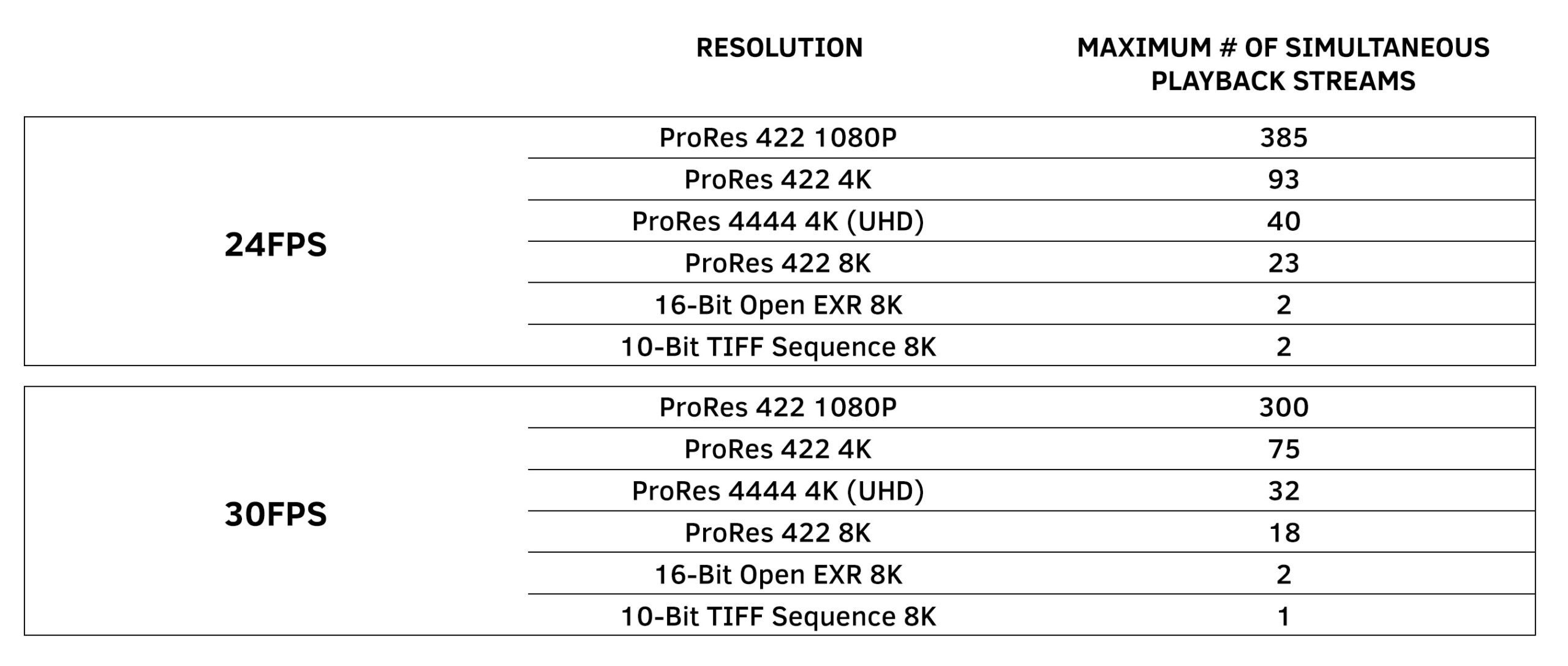
Play multiple streams of HD, 4K, 8K, or EXR simultaneously with 5.2GB/s reads.

Table displaying maximum simultaneous playback streams for various resolutions and formats, emphasizing Iodyne Pro Data's capability in efficient media workflows.
See how many streams you can play back

How long does it take to ingest 10TB?

Chart comparing data transfer times for Iodyne Pro Data, typical 8-bay RAID, and typical SSD, highlighting Pro Data's 1h 9m for 10TB at 2400MB/s sustained write speed, emphasizing efficiency in media workflows.

Cost of investment recouped in days, not months of production.

Let us do the math with you.

Don’t hesitate to contact us with a heavyweight workflow problem; our workflow experts and engineers would be more than happy to take the challenge.

Connect with a workflow expert
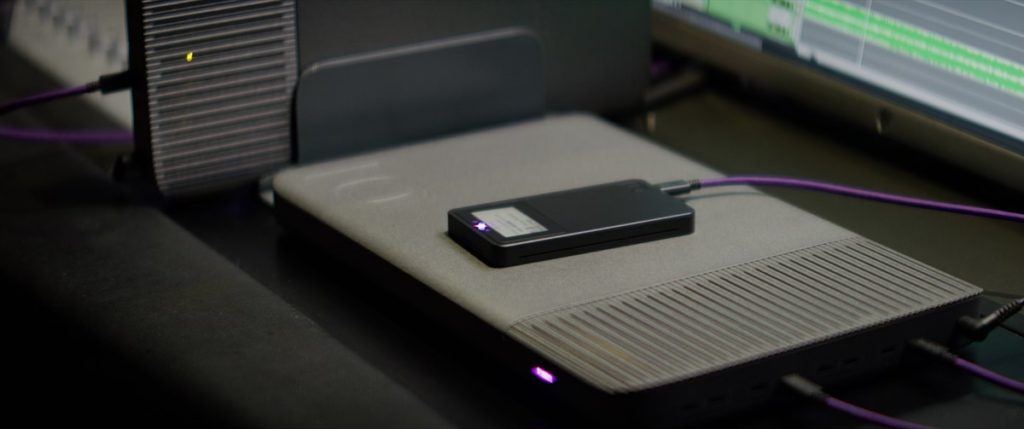
Data storage devices connected to a workstation, highlighting Iodyne's Pro Data technology for efficient media workflows and high-speed data transfer.